
Folding treadmill review
The Q8 is where the Home Fitness Code range stops being walking pads and becomes actual treadmills: handrails, a console, preset programs, a safety key and a 7.5 mph top speed for £179.99. This review covers what that buys, the honest limits of the cheapest running-capable machine in the range, and whether the Q8 Pro is worth £70 more.
Home Fitness Code Q8 at a glance
Home Fitness Code Q8
£339.99£179.99Sold as a folding treadmill in black with a safety key included. At our August 2026 check the version without the floor mat was on backorder, so the with-mat bundle was the one actually shipping. Prices are the standing sale prices against RRP and move with sales.
Who the Q8 is for
What £179.99 actually buys
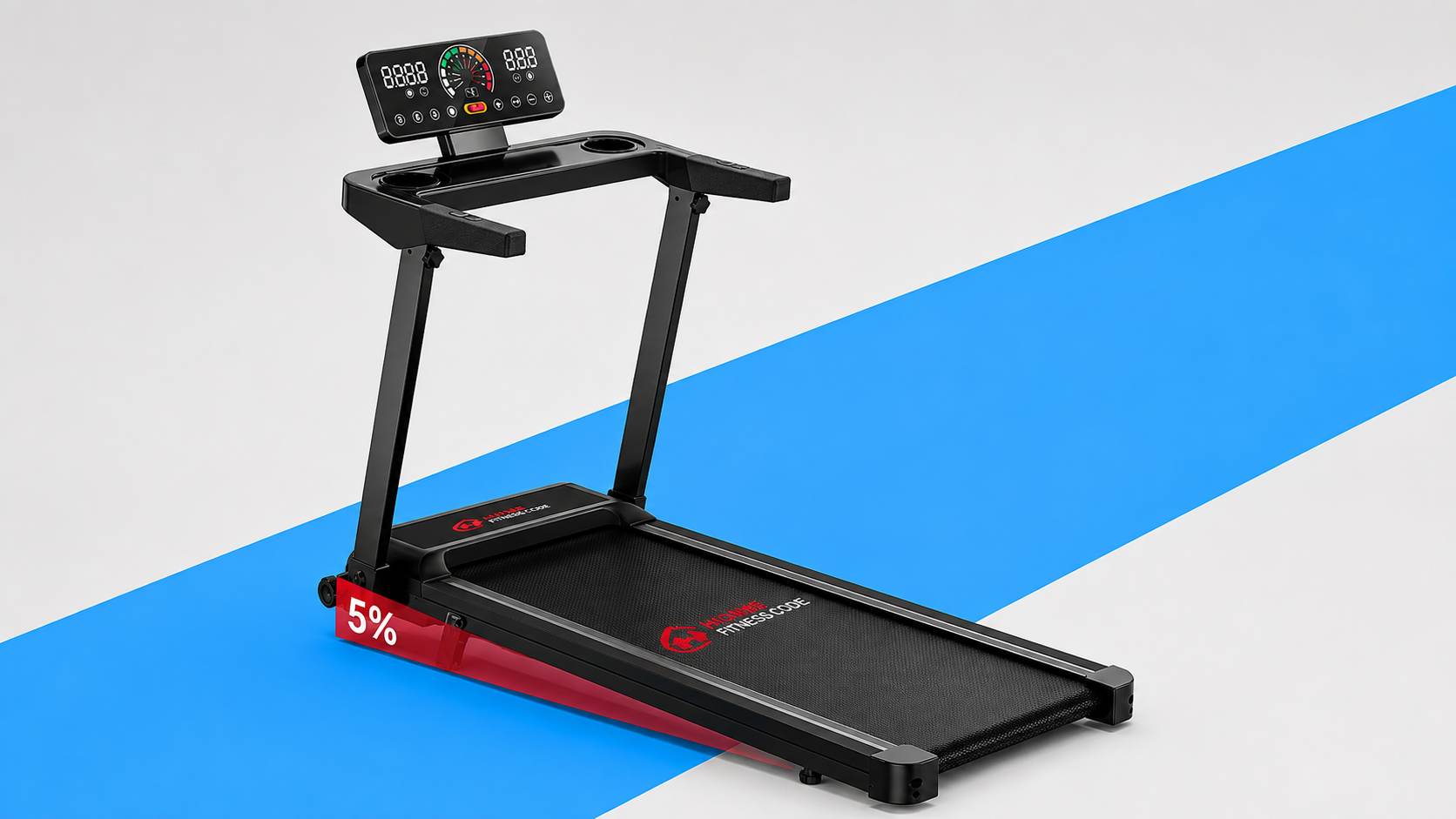
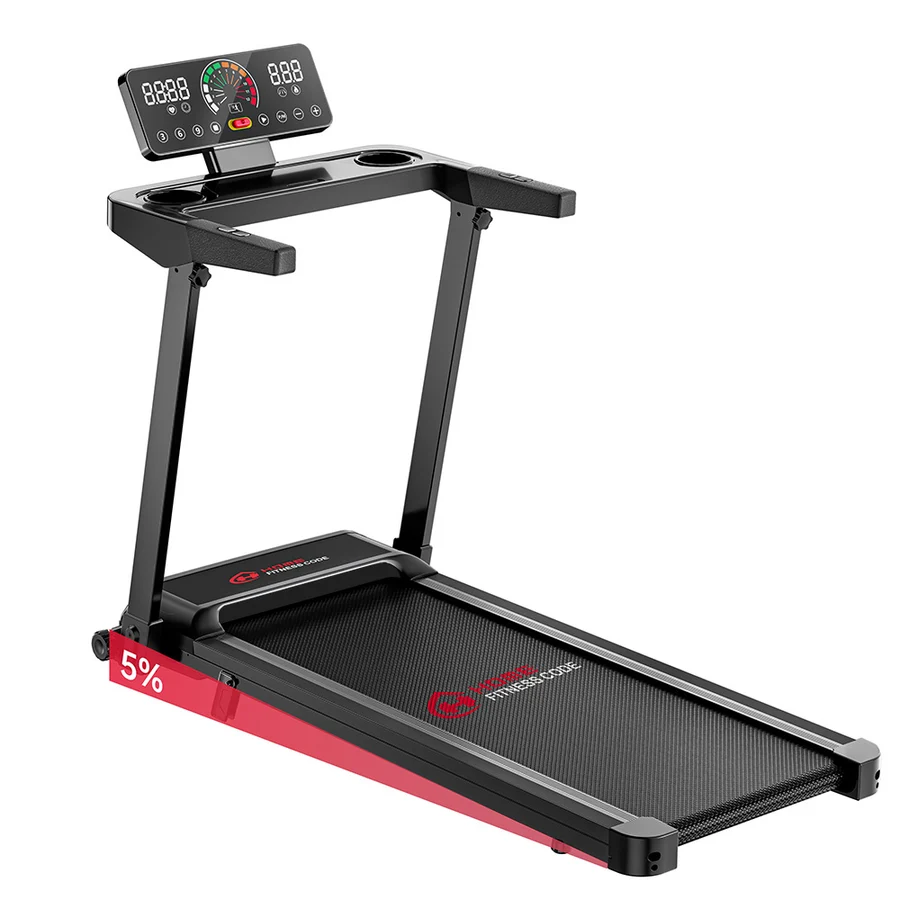
Every machine below the Q8 in the Home Fitness Code range is a walking pad: a low deck, a remote, and a ceiling of 6.2 mph. The Q8 is the first model built like a conventional treadmill. You get a folding frame with handrails, a console mounted where your hands rest, twelve preset workout programs, pulse sensors in the grips and a clip-on safety key that kills the belt if you come off the back. None of that is exotic, but at £179.99 against a £339.99 RRP it is a genuinely short bill for the full treadmill format.
The headline numbers are strong for the money too. The 3.0 HP peak motor is the joint largest Home Fitness Code fits, shared only with the flagship Q8 Pro, and the 150 kg maximum user weight matches the sturdiest machines in the range, a clear step up from the 120 kg rating on the Q2 Pro and C1 pads. For heavier users wanting to run rather than walk, that rating is the Q8’s quiet selling point.
Where the price shows is in what is missing, and the honest list is real: the incline is manual, there is no remote, there is no app support, and Home Fitness Code does not publish the Q8’s deck dimensions or unit weight prominently. Each of those is covered in its own section below.
Speed: can you actually run on it?
The Q8 runs from a slow walk up to 7.5 mph (12 km/h). In practical terms that covers everything from desk-pace strolling through brisk walking and jogging into genuine light running; 7.5 mph is roughly an 8-minute-mile ceiling. For couch-to-5k plans, interval jogging and steady 20 to 30 minute runs, the speed range is honestly enough.
What it is not is a runner’s treadmill. Sustained fast running wants 10 mph or more of headroom and a deck long enough for a full stride at pace, and budget folding machines in this class give you neither. Regular runners, or anyone training for pace rather than fitness, should treat the Q8 as a stepping stone and read our folding treadmills guide or cheap treadmills roundup for machines built for the job. For everyone else, the gap between a 6.2 mph pad and the Q8’s 7.5 mph with handrails is the gap between jogging carefully and running normally.
Incline: 5%, set by hand
The Q8 carries a 5% manual incline. Manual means exactly that: you set the gradient by hand before you start, not from the console mid-session. As a way to add a little intensity to walking and jogging it works, and 5% is enough to feel; as a training tool it is limited, because you cannot vary the gradient during a workout the way the programmed hill profiles on dearer machines do.
If incline is the reason you are shopping, the range answers it two ways. The Y3 at £169.99 gives a remote-adjusted 12% automatic incline at walking speeds, and it is the better buy for incline-led routines. The Q8 Pro at £249.99 pairs running speeds with a 20-level automatic incline. The Q8 sits between them as the speed-first choice where incline is a bonus.
Console, programs and the missing remote
The console lives on the handrail crossbar and covers the essentials: speed control, the twelve preset programs, and readouts driven by the pulse grips in the rails. The presets vary speed automatically through a session, which is the closest the Q8 gets to coached training and a real advantage over the range’s pads, none of which carry programs at all.
Two omissions to know about before buying. There is no remote control: unlike the walking pads, everything is done at the console, which is a non-issue on a handrail machine you stand at but worth knowing if you expected one in the box. And there is no third-party app support: the Q8 does not connect to Zwift, Kinomap or a phone app, so your workout data lives on the console display and nowhere else. At this price we would call both acceptable; at £300 we would not.
Build, the 150 kg rating and the flat fold
The frame is the Q8’s strongest suit on paper: a 150 kg maximum user weight equals anything Home Fitness Code sells and betters most budget rivals, and the handrails give the stability at jogging pace that no handrail-free pad can. The safety key is standard, as it should be on any machine with running speeds.
Storage works differently from the upright folders most buyers picture. The Q8 folds flat rather than upright: the frame drops level for sliding under a bed or standing on edge against a wall with care, but it does not fold vertically into a compact standing block. If your storage plan is a treadmill standing upright in a corner, the Q8 does not do that, and it is the one storage question to settle before ordering.
Two specification gaps are worth flagging honestly: Home Fitness Code does not prominently publish the Q8’s deck dimensions or unit weight. Taller runners in particular should confirm the deck length with support at the address in our treadmill guide before ordering, since stride room matters more at 7.5 mph than it does at walking pace.
Q8 vs Q8 Pro: which to buy
| Model | Top speed | Incline | Console | Max user | Price |
|---|---|---|---|---|---|
| Q8 | 7.5 mph | 5% manual | Buttons + programs | 150 kg | £179.99 £339.99 |
| Q8 Pro | 8.7 mph | 20-level auto | Touch + programs | 150 kg | £249.99 £459.99 |
The £70 question splits on incline. Both machines share the 3.0 HP motor, the 150 kg rating, twelve programs and the folding-handrail format. The Q8 Pro adds 1.2 mph of speed, a touch console and, decisively, a 20-level automatic incline that turns it into a genuine hill-training machine. If your workouts will ever lean on gradient, the Pro is worth the £70 and is the flagship of the range for a reason. If you want flat jogging and running with the occasional hand-set slope, the standard Q8 does the same core job and keeps the £70. Our treadmill range guide compares both against the Y-series incline pads.
What owners say
Home Fitness Code’s store reviews run at roughly 90% four and five stars across the range, and the Q8’s own review base is thinner than the walking pads’, which sell in larger numbers. The recurring themes across the brand apply here and are worth taking seriously on a boxed treadmill: a minority of buyers report courier damage on arrival, slow email support, and some noise during assembly and first runs that settles or needs bolts re-checking. The sensible routine is the one we give for every machine the brand sells: unbox and check the frame the day it arrives, test every function inside the 30-day return window, and photograph any damage immediately. Our brand guide covers the legitimacy question and the support record in full.
Warranty, returns and support
The Q8 carries Home Fitness Code’s standard 12-month warranty, handled by email with posted parts rather than an engineer visit, alongside 30-day returns, Klarna and PayPal instalments at the checkout and a student discount. That is typical for a budget direct-sell brand and honestly short of the two-year in-home cover JTX offers on machines costing three times as much; you are trading cover length for price, and the trade is transparent. Fault codes and basic maintenance are covered in the troubleshooting section of our treadmill guide.
Pros and cons
- 7.5 mph covers jogging and light running, not just walking
- 3.0 HP peak motor, the joint largest in the range
- 150 kg frame rating, unusual at the price
- Twelve programs, pulse grips and a safety key included
- £179.99 against a £339.99 RRP, with Pay in 3
- 5% incline is manual, set by hand before you start
- No remote and no third-party app support
- Folds flat, not upright, so it will not stand in a corner
- Deck size and unit weight not prominently published
- 12-month posted-parts warranty
RunRank breakdown
Frequently asked questions
Is the Home Fitness Code Q8 good for running?
For jogging and light running, yes: 7.5 mph (12 km/h) with handrails and a safety key covers couch-to-5k plans and steady runs. For regular or fast running it is not the right machine; a longer deck and a 10 mph plus ceiling from our folding treadmills guide serve runners better.
Does the Q8 fold upright?
No. The Q8 folds flat rather than vertically, so it slides under a bed or sofa rather than standing upright in a corner. If upright storage is essential, look elsewhere in our folding treadmills guide.
Does the Q8 work with Zwift, Kinomap or an app?
No. The Q8 has no third-party app connectivity, so workout data stays on the console. Within the range that is normal; none of the Home Fitness Code machines offer app support.
Does the Q8 come with a remote?
No. Unlike the brand’s walking pads, the Q8 is controlled entirely from the handrail console, which is where your hands are anyway on a machine of this format.
How does the Q8’s manual incline work?
The 5% gradient is set by hand before a session rather than adjusted from the console during one. It adds useful intensity to walking and jogging, but for gradient you can change mid-workout you want the Y3 or the Q8 Pro, both with automatic incline.
Should I buy the Q8 or the Q8 Pro?
Buy the Q8 if you want flat running for the least money. Buy the Q8 Pro if incline training matters: £70 more buys a 20-level automatic incline, 8.7 mph and a touch console. Both share the motor, the programs and the 150 kg rating. Our treadmill range guide has the full comparison.
Ready to check the Q8?
£179.99 against a £339.99 RRP for 7.5 mph, a 3.0 HP motor, twelve programs and a 150 kg frame. Confirm the current price, stock and the mat bundle directly with the retailer.
This review is based on manufacturer specifications, published product information and verified owner feedback, not a hands-on trial, and we say so plainly. Prices checked August 2026 and subject to change. HomeTreadmill.co.uk is reader-supported: if you buy through links on this page we may earn a commission, at no extra cost to you. This does not influence our assessment. The Q8 is scored with our RunRank system, an editorial score and not a measure of customer ratings.