

Treadmill Review
The NOHrD Sprintbok is a curved, motorless treadmill that runs on nothing but your own legs. Hand-made in Germany from solid hardwood, it sits right at the top of the home treadmill market at £6,299, so this review looks at exactly what you get for that, how it runs, and who a curved manual treadmill like this is really for.
Self-powered curved manual treadmill, hand-made in Germany by the makers of WaterRower.
Check price at Fitness Options →- Power None, self-powered
- Top speed No limit, you set it
- Running surface 160 x 45 cm slats
- Max user 160 kg
- Maintenance Maintenance-free
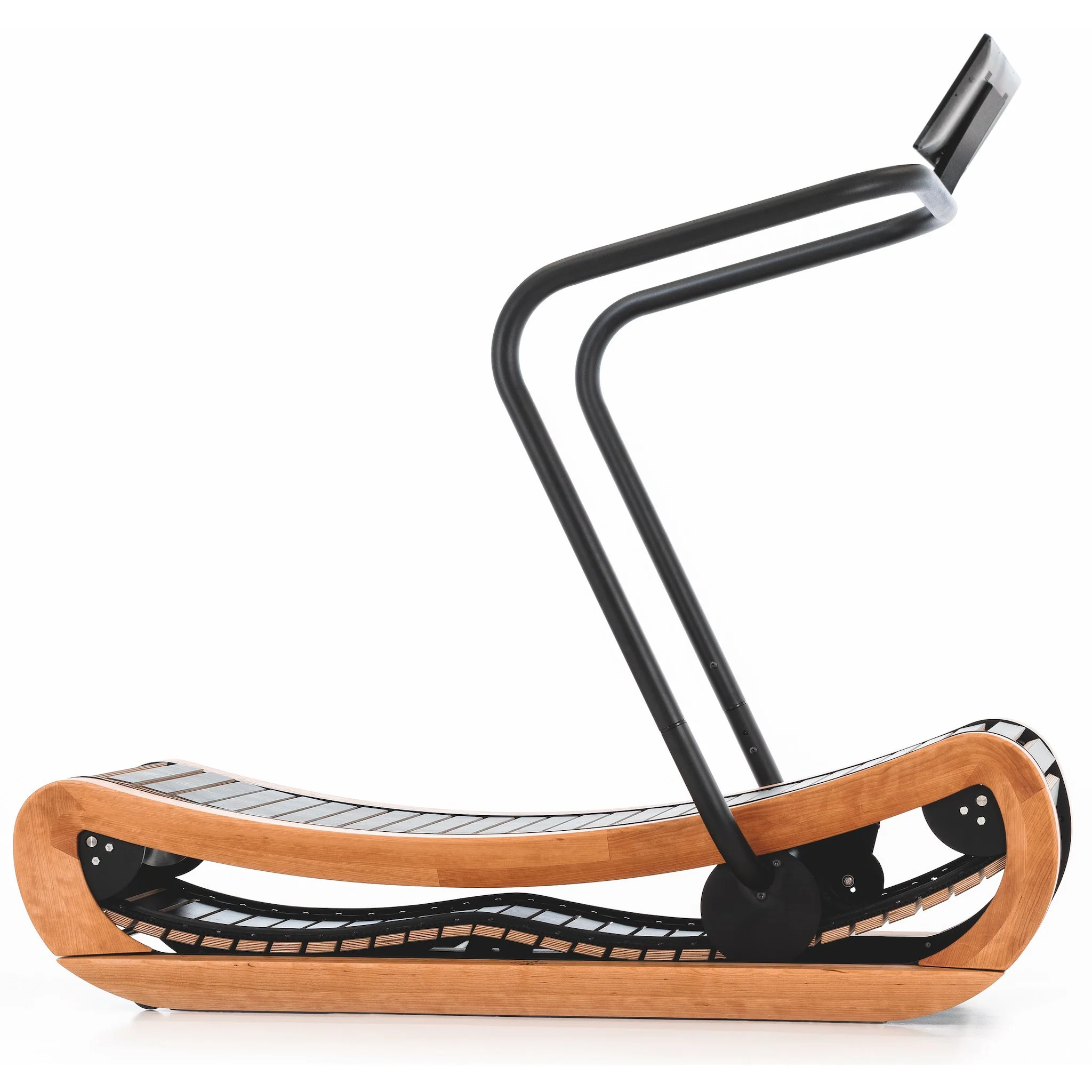
Most of the treadmills we review are motorised machines built around a price. The Sprintbok is something else entirely. It is a curved manual treadmill from NOHrD, the wooden-equipment arm of WaterRower, with no motor, no power cord and no fixed speed. The belt moves only when you do. Push off the curved slats and it accelerates, ease back and it slows, stop and it stops. You set the pace with your body, not a console.
That makes it as much a piece of furniture and a statement as a workout tool, which is part of the point at this price. But it also runs genuinely differently from anything motorised, so it is worth understanding before spending six thousand pounds.
What is a curved manual treadmill?
A curved manual treadmill has no motor. Instead of a flat belt driven at a set speed, the deck curves upward at both ends, and your foot strike drives the slatted belt backwards. Where you stand on the curve controls your pace: move towards the front and you speed up, drift back towards the middle and you slow down. There is no maximum speed, because nothing is capping it. The pace is simply how hard you push.
The pay-off is a more demanding, more natural run. Because you are powering the belt yourself, a curved manual treadmill works more muscles and, by NOHrD’s figures, burns up to around 30% more calories than a motorised belt at the same perceived effort. The curve also nudges your foot strike towards the midfoot and forefoot, closer to how you run on the ground than the heel-strike a flat motorised belt tends to encourage. That makes it a favourite for sprint intervals, tempo work and running-form training.
Build and materials
This is where the Sprintbok earns its price. Each one is hand-made in Germany from sustainable solid hardwood, available in six finishes: Cherry, Oak, Walnut, Club, Shadow and Vintage. The running surface is built from 62 flexible wooden slats, each topped with a linoleum tread for grip, mounted on precision ball bearings over a powder-coated steel base. Natural rubber damping keeps it quiet and absorbs vibration through every stride.
Because there is no motor or drive belt, it is effectively maintenance-free. There is no lubrication, no belt tensioning and no electrical parts to fail, just the occasional dusting. It is a substantial machine at roughly 100 kg with a footprint of about 180 by 86 cm and around 150 cm tall, but two built-in rollers let you tip and wheel it into place. Build quality is genuinely commercial-grade, which is why you also find the Sprintbok in boutique studios and gyms.

The running experience
On the Sprintbok you feel the difference immediately. It takes more effort to get moving and to hold a pace than a motorised treadmill, which is exactly the appeal for fitter runners but can be a surprise if you are used to setting a speed and zoning out. The 160 by 45 cm slatted deck is a good size, the flexion system cushions each step to protect your joints, and the whole thing runs remarkably quietly thanks to the rubber damping.
It shines for intervals, sprints and conditioning, where instant, infinite pace control with no buttons is a real advantage. It is less suited to gentle, distracted strolling, since you have to keep driving the belt the whole time, and it supports users up to 160 kg.
Console, app and connectivity
A sturdy handlebar holds an integrated display that shows your live data, time, distance, pace and calories, with no phone required. From there you can sync to the NOHrD Connect app for session history, goal tracking and structured programmes, or pair with the third-party running apps you already use. There is a holder for a tablet up to 17.3 inches, and heart rate tracking is supported via an optional chest strap. It is a clean, modern setup, though deliberately simpler than the big touchscreens on motorised flagships, there are no on-board video workouts or auto-incline here, because there is no motor to drive.

See it in action
Our overall RunRank is a weighted view across the four pillars, not a flat average. The Sprintbok scores superbly on build and running quality; the price is what holds the value score back.
- Stunning, commercial-grade German hardwood build
- Self-powered: no electricity, no motor to fail, maintenance-free
- Curved deck encourages natural form and burns more
- No speed limit, superb for sprints and intervals
- Quiet and joint-friendly
- Very expensive at £6,299
- Harder work than a motorised belt, less suited to gentle walking
- No powered incline or on-board video workouts
- Large and heavy, a serious commitment
Who should buy it
The Sprintbok makes sense for three kinds of buyer: serious runners who want intensity, instant pace control and better form; design-led buyers who want a beautiful object that happens to be a treadmill rather than a slab of black plastic; and studios or commercial spaces wanting a durable, maintenance-free, zero-running-cost machine. If you mainly want gentle walking, motorised incline, on-board classes or simply the lowest price, a conventional treadmill will serve you better, and we cover those in our folding treadmill and home treadmill guides.
Price, finishes and warranty
The Sprintbok is £6,299 and comes in six hardwood finishes (Cherry, Oak, Walnut, Club, Shadow and Vintage), so you can match it to your room. It is covered by a one-year warranty on all components and wooden parts as standard, upgradeable to two years when you register the product within the first year. Set against its lifespan, zero electricity cost and maintenance-free design, the long-term cost of ownership is lower than the sticker alone suggests, though it is still a significant outlay.
Full specifications
| Type | Curved manual (self-powered) treadmill |
| Motor | None, user-powered |
| Top speed | No limit, fully user-controlled |
| Running surface | 160 x 45 cm, 62 wooden slats with linoleum tread |
| Cushioning | Flexion slat system on ball bearings, natural rubber damping |
| Display | Integrated console; NOHrD Connect app and third-party app sync |
| Heart rate | Optional chest strap; tablet holder up to 17.3 in |
| Finishes | Cherry, Oak, Walnut, Club, Shadow, Vintage |
| Footprint | Approx. 180 x 86 cm, around 150 cm tall |
| Unit weight | Approx. 100 kg (two transport rollers) |
| Max user weight | 160 kg |
| Maintenance | Maintenance-free, no oiling or belt tightening |
| Warranty | 1 year, upgradeable to 2 years on registration |
| Price | £6,299 |
Frequently asked questions
How does a curved manual treadmill work without a motor?
Your stride drives it. The deck curves upward, so as you push off the slats the belt moves with you. Speed up by running towards the front of the curve, slow down by drifting back. Stop pushing and the belt stops. There is no motor and no set speed.
Is the NOHrD Sprintbok worth £6,299?
It depends on what you value. For build quality, running feel, longevity and design it is exceptional, and it has no running or maintenance costs. As pure exercise value per pound it is expensive, so it suits buyers who want the best curved manual treadmill and a beautiful object, rather than the cheapest way to run indoors.
Does it need electricity?
No. The treadmill is entirely self-powered, so there are no power cables and no running costs. You can place it anywhere without needing a socket nearby.
Does a curved treadmill burn more calories?
Generally yes. Because you power the belt yourself, a curved manual treadmill engages more muscle and, by NOHrD’s figures, can burn up to around 30% more calories than a motorised treadmill at a similar effort.
What is the maximum user weight?
The Sprintbok supports users up to 160 kg.
Is it hard to run on?
It takes more effort than a motorised belt, which is the point for fitter runners. That makes it brilliant for sprints and intervals but less relaxing for gentle, distracted walking, since you have to keep driving the belt throughout.
The verdict
The NOHrD Sprintbok is not trying to compete with motorised treadmills on price or features, and judged that way it would look expensive. Judged on what it actually is, a hand-made, self-powered, maintenance-free curved treadmill that runs beautifully and looks like furniture, it is one of the best of its kind you can buy. If you want intensity, natural running form and a machine built to last decades with no running costs, and the budget is there, it earns its place. If you want gentle walking, incline programmes or value, look to a motorised model instead.
Check price at Fitness Options →We research and compare products independently using our RunRank system. If you buy through links on this page we may earn a commission, at no extra cost to you. Prices are checked regularly and change with sales, so always confirm the current price on the retailer’s site.