
Reebok Treadmill Review
The Reebok FR20z Floatride makes an unusual bet: instead of folding, it invests everything in build quality, cushioning and connectivity. A fixed deck for gym-like stability, Floatride+ cushioning inspired by Reebok’s running shoes, both Zwift and Kinomap compatibility, and a 10-year motor warranty, now at £699. Here is our full assessment of who it suits, where it compromises, and how it compares with its siblings and rivals.
Best value fixed-deck runner under £700
Save £200 on the 2026 price
£899 £699
Sweatband sale price at the time of writing. The FR20z sold for £799 to £899 through most of 2026.
Check price at Sweatband →- Top speed11 mph (18 km/h)
- Motor2.25 HP peak (eco-Kinetic)
- Deck140 x 46 cm, fixed
- Incline15 levels, power
- Max user120 kg
- Warranty10yr motor / 2yr P&L
What is the Reebok FR20z Floatride?
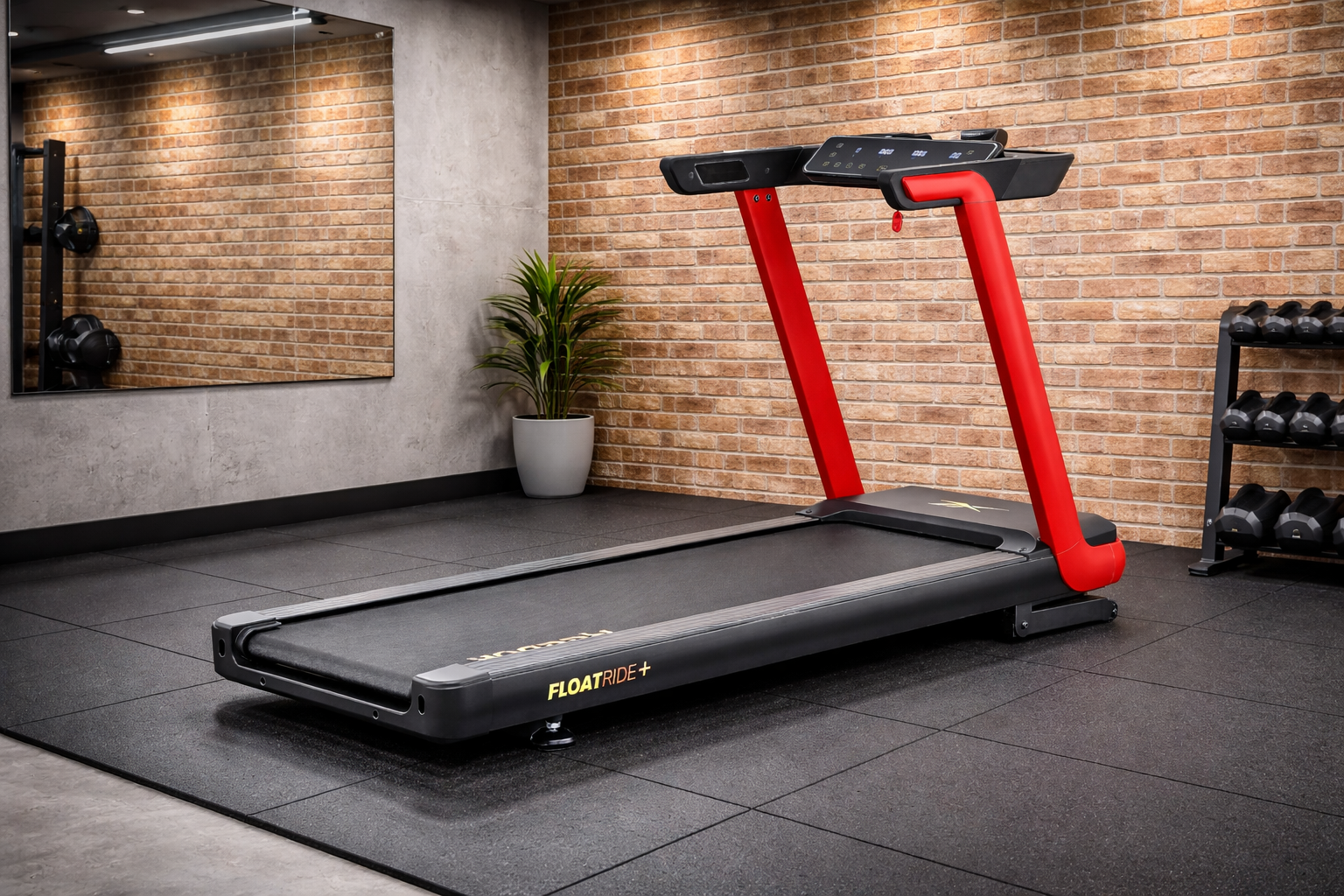
The FR20z is the smaller of Reebok’s two Floatride treadmills, sharing the same design language, the same Floatride+ cushioning system and the same app compatibility as the FR30z in a more compact, more affordable package. A 2.25 HP peak eco-Kinetic motor drives speeds from 0.6 to 11 mph (18 km/h) across 15 levels of powered incline, on a 140 x 46 cm fixed deck. The slimline touch-response LED console pivots for viewing angle, runs 32 programmes, and connects over Bluetooth to both Zwift and Kinomap.
The trade-off is simple and non-negotiable: this machine does not fold. If you have permanent floor space for a treadmill, the FR20z delivers a running experience that punches well above its price. If you do not, our folding treadmills guide is the place to look instead.
Who should buy the Reebok FR20z?
The FR20z suits dedicated home runners with a spare room, garage or permanent workout space who want a machine that feels like a gym treadmill rather than a piece of home fitness equipment. It suits people who value running comfort above all else: the Floatride+ cushioning is genuinely a different experience from the basic shock absorption on budget treadmills. And it suits connected runners who want Zwift or Kinomap integration without paying £999 for the FR30z.
It is not for anyone who needs to store their treadmill away after sessions; the fixed deck has no workaround, and while transport wheels allow repositioning, this is a 72 kg machine with a permanent 177 x 69 cm footprint. There is no touchscreen or iFIT-style guided coaching on the console itself, so app training runs from your own phone or tablet on the media dock. And very tall runners should note the 140 cm deck: adequate up to about 6 ft 1, but if you are taller with a long stride, the FR30z’s 150 cm deck is the better choice.
Floatride+ cushioning, the headline feature
The Floatride+ system is why this treadmill exists. Named after Reebok’s Floatride running shoe technology, it places eight cushioning zones strategically along the deck. The zones absorb impact energy on foot strike and provide a firmer surface at the push-off point, exactly how a well-designed running shoe works, but built into the deck itself. The result sits between the soft, bouncy feel of foam-based cushioning and the firm, road-like feel of an uncushioned commercial deck. Your ankles and knees notice the difference immediately, and user reviews consistently single out the running feel as the FR20z’s standout quality.
The cushioning matters more the longer you run. On a 20-minute walk, virtually any treadmill feels acceptable; at 45 minutes of jogging, the accumulation of thousands of foot strikes amplifies the difference between good and poor cushioning. It also matters more for heavier runners, because the zones compress proportionally to the force applied.
One point worth underlining for the FR20z vs FR30z decision: both machines use identical Floatride+ technology with the same number of cushioning zones. You are not getting a cheaper, watered-down version of the cushioning. You are getting exactly the same system in a slightly smaller frame.
The fixed deck: feature, not flaw
The FR20z does not fold, and that is a deliberate engineering choice rather than a cost-cutting measure. A fixed deck eliminates the hinge point every folding treadmill carries somewhere in its frame, a hinge that introduces flex, movement and potential noise under load. The result is a machine that feels planted and remarkably quiet: at 10 mph on a gradient, where a folding treadmill’s hinge can produce subtle lateral movement, the FR20z stays dead still. The fixed frame also transmits less vibration through the floor, which matters for anyone training in an upstairs room.
The footprint is 177 x 69 cm, comparable to a single bed in width and slightly shorter in length, and the 115 cm height means it sits unobtrusively in a room. The minimalist design with coloured support pillars reads as a piece of design rather than a domestic appliance. Floor-level adjusters handle uneven flooring, and front transport wheels let one person tilt and roll the machine for cleaning or repositioning, though at 72 kg you will not be moving it casually.
Motor, speed and incline
Reebok’s eco-Kinetic motor delivers 2.25 HP peak output, drawing less power than a comparable standard motor while running cooler and quieter. It drives the belt smoothly across the full 0.6 to 11 mph range with no hesitation at speed changes. At 11 mph, a 5:27 mile pace, the FR20z is fast enough for serious running training; the FR30z’s 12.4 mph ceiling buys you only 1.4 mph more. Reebok backs the motor with a 10-year warranty, which is among the strongest at this price and a statement budget manufacturers simply cannot make.
Fifteen powered incline levels give meaningful hill-training capability, with quick-incline buttons on both the console and the handrails for instant jumps mid-interval. The range comfortably covers the 12-3-30 workout, the 24 preset programmes vary speed and incline together for rolling-hill sessions, and Kinomap’s terrain matching can drive the incline to follow real-world routes.
Noise is genuinely low. No hinge means no hinge-related noise, and the motor itself is quiet: at walking speeds you can comfortably take a phone call, and at jogging speeds your footfall is the dominant sound. That matters for home office use, early sessions and flats with neighbours.
Zwift and Kinomap: the differentiator
The FR20z connects over Bluetooth to both Zwift and Kinomap, and this dual compatibility is its most powerful advantage at the price. Zwift is the bigger platform: a virtual world where your treadmill data drives an avatar alongside other real runners, with structured training plans and real social motivation, for around £17.99 a month. Kinomap offers real-world video routes filmed across every continent, with the FR20z adjusting its incline to match the terrain; a 30-day free trial is included, then roughly £9.99 a month.
At this price the alternatives typically offer one platform, none, or a locked ecosystem. NordicTrack machines steer you into iFIT at roughly £39 a month after the trial year; the Reebok Jet 200 supports only Kinomap. The FR20z gives you both major running platforms and the freedom to choose either, both or neither: in manual mode it works perfectly well with its 32 onboard programmes, Bluetooth speakers and media dock, so app connectivity is a bonus, not a requirement.
The console and display
The console is a departure from the chunky plastic dashboards common in this bracket: a slimline touch-response LED strip sitting flush with the crossbar, with an adjustable pivot and an illuminated bezel that makes it easy to read mid-run. Live feedback covers speed, time, distance, calories, pulse and incline. Quick speed and incline buttons sit on both the console and the handrails, with the handrail placement particularly useful for steep incline walking, and hand pulse sensors are integrated for heart rate.
For guided coaching visuals or streaming you place your own tablet on the media dock; the console has no screen of its own for apps or media. Large built-in screens really only arrive with the far more expensive NordicTrack Commercial range or the Peloton Tread. For metric-focused runners, the slimline design works well, and we rate the design language of both Floatride machines highly.
How does it compare?
FR20z vs FR30z (£999). The FR30z is the superior machine in every dimension: faster (12.4 mph vs 11 mph), a wider and longer deck (150 x 51 cm vs 140 x 46 cm), a higher 150 kg user limit, plus a cooling fan, USB charging and a wireless heart rate receiver the FR20z lacks. The critical detail is what they share: identical Floatride+ cushioning, identical Zwift and Kinomap support, identical 15-level incline and the identical 10-year motor warranty. At £699 the FR20z now delivers roughly 80% of the FR30z experience for 70% of the price, which makes it the value play. The FR30z is for runners who will genuinely use the extra deck space and speed headroom.
FR20z vs Reebok Jet 200 (around £799). The Jet 200 now costs £100 more for a similar spec sheet: same deck size, same 11 mph top speed, same 15 incline levels, same 120 kg limit, same warranty. Its advantages are Air Motion cushioning, a soft-drop hydraulic fold, a cooling fan and USB charging. The FR20z counters with Floatride+ (arguably the more refined system), Zwift support (the Jet 200 is Kinomap only), fixed-deck stability, better aesthetics and the lower price. If you need folding, buy the Jet 200; if you want Zwift or prioritise the running feel, the FR20z is the better machine for less money.
FR20z vs NordicTrack T Series 5 (around £599 to £699). The T Series 5 matches the deck size, adds a slightly stronger 2.6 CHP motor, a 135 kg user limit, 21 incline levels and a year of iFIT with auto-adjusting trainer workouts. The FR20z counters with Floatride+ cushioning against KeyFlex, open Zwift and Kinomap support against iFIT lock-in at roughly £39 a month after year one, and arguably better build quality. Neither folds. If you want guided coaching and will commit to iFIT, the NordicTrack is excellent; if you want freedom in your apps and a better running surface, the FR20z edges ahead, and at £699 the price gap between them has nearly closed.
Build quality and assembly
The FR20z looks unlike anything else in its bracket: coloured support pillars, a slimline console blended into the crossbar and a low-profile motor hood, where rivals use black plastic shrouds and chunky dashboards. The fixed steel frame is robust, the 72 kg mass contributes directly to the stability, and rubberised side rails give a safe stepping surface for rest intervals. A storage area behind the console and a device holder handle the practicalities.
Assembly is remarkably simple: Reebok claims 15 minutes and 90% pre-built, and user reviews confirm it. The deck arrives assembled; you attach the uprights, connect the console and plug in. One person can manage the build, though you will want help lifting the main frame from the box. All tools are included.
What the FR20z lacks
Honestly, not much at £699, but the omissions are consistent in user feedback. There is no cooling fan (the FR30z has one), so long sessions in warm rooms need a standalone fan. There is no USB charging port, noticeable when your phone is streaming Zwift for 45 minutes over Bluetooth. Heart rate is hand-pulse only, with no wireless receiver for chest straps, a meaningful gap if heart rate zone training is central to your running. The 46 cm belt is standard for the price and adequate for most, but the FR30z’s 51 cm belt is noticeably more spacious. And, already covered but worth restating: it does not fold. Measure your space before buying.
Warranty
The package is a genuine strength: 10 years on the motor, 2 years parts and labour, with UK phone and chat support. That is the same structure as the £999 FR30z and the Jet 200, so you are not compromising on after-sales protection by choosing the cheaper Floatride. Against the JLL compact range (typically 12 months across the board) and the NordicTrack T Series 5 (10-year motor and 2-year parts and labour only if registered within 28 days), the FR20z’s cover is both longer and less conditional.
Our overall RunRank is a weighted view across the four pillars, not a flat average. The Floatride+ cushioning, fixed-deck stability and dual app support carry the score; the missing fan, USB and wireless heart rate, and the 120 kg user limit, keep it honest against its own sibling. How RunRank works.
- Floatride+ cushioning, a measurable step up at this price
- Both Zwift and Kinomap, no ecosystem lock-in
- Fixed deck delivers gym-like stability and low noise
- 10-year motor warranty, unconditional
- 15 levels of powered incline with handrail quick keys
- Striking design that suits a living space
- 15-minute assembly, 90% pre-built
- Does not fold, permanent 177 x 69 cm footprint
- No cooling fan or USB charging (both on the FR30z)
- Hand pulse heart rate only, no wireless receiver
- 120 kg user limit trails the NordicTrack T5’s 135 kg
- 46 cm belt is adequate rather than generous
Full specifications
| Model number | RVFR-10121GRZ |
| Top speed | 11 mph (18 km/h), range from 0.6 mph |
| Motor | 2.25 HP peak (eco-Kinetic) |
| Running deck | 140 x 46 cm, fixed |
| Incline | 15 levels, power |
| Cushioning | Floatride+ (8 strategically placed zones) |
| Programmes | 32 total (24 pre-set, 3 user-defined, 3 target, manual, body fat) |
| Display | Slimline touch-response LED, adjustable pivot, illuminated bezel |
| Connectivity | Bluetooth, Zwift and Kinomap compatible |
| Heart rate | Hand pulse sensors on handrails |
| Entertainment | Surround sound Bluetooth speakers, smart device media dock |
| Folding | No, fixed deck |
| Max user weight | 120 kg (18 st 13 lb) |
| Assembled dimensions | 177 x 69 x 115 cm (L x W x H) |
| Machine weight | ~72 kg |
| Extras | Storage area behind console, transport wheels, floor level adjustment, emergency stop clip |
| Warranty | 10 years motor, 2 years parts and labour |
| Price | £899 £699 at Sweatband |
Frequently asked questions
How much does the Reebok FR20z cost?
Sweatband sells the FR20z for £699 at the time of writing, down from the £799 to £899 it sold for through most of 2026. Sale prices change regularly, so confirm the live figure at the checkout.
Does the FR20z fold?
No. The FR20z has a fixed, non-folding deck, a deliberate design choice that improves stability, reduces noise and eliminates hinge wear. It has transport wheels for repositioning, but the 177 x 69 cm footprint is permanent. If you need a folding treadmill, the Reebok Jet 200 offers similar specs with a hydraulic upright fold.
What is the difference between the FR20z and the FR30z?
The FR30z (£999) has a more powerful 4.0 HP motor, a faster 12.4 mph top speed, a larger 150 x 51 cm deck, a higher 150 kg user limit, plus a cooling fan, USB charging and a wireless heart rate receiver. Both use identical Floatride+ cushioning, both support Zwift and Kinomap, and both carry a 10-year motor warranty. At £699 the FR20z gives you roughly 80% of the FR30z for 70% of the price.
Does the FR20z work with Zwift?
Yes, fully, via Bluetooth, and it supports Kinomap as well. Dual platform compatibility is one of the FR20z’s key differentiators; most treadmills at this price support one platform or none. A 30-day free Kinomap trial is included, and Zwift requires its own subscription.
Can you do the 12-3-30 workout on the FR20z?
Yes. The 15 levels of powered incline provide sufficient gradient. Set the incline, set 3 mph, and walk for 30 minutes; the Floatride+ cushioning makes extended incline sessions particularly comfortable. See our full 12-3-30 guide.
Is the FR20z quiet?
Very. The eco-Kinetic motor and the fixed deck together produce remarkably little noise: at walking speeds the motor is nearly inaudible, and at running speeds your footfall is the primary sound. Suitable for home office use, early morning sessions and flats with neighbours.
How long does assembly take?
Approximately 15 minutes. The deck arrives 90% pre-assembled; you attach the uprights, connect the console wiring and secure with the included tools. One person can complete the build, though a second pair of hands helps when lifting the 72 kg frame from the box.
How does Floatride+ compare to Air Motion on the Jet 200?
Both are 8-element zone-based cushioning systems and both are substantial improvements over basic deck cushioning. Floatride+ uses shock-absorbing zones inspired by Reebok’s running shoes, cushioning on landing and firming at push-off; Air Motion uses air-filled pods that transfer air between chambers. User feedback suggests Floatride+ feels slightly smoother and more consistent, Air Motion more noticeably responsive. The difference is subtle.
The verdict
The FR20z earns its 3.5 RunRank by delivering a genuinely premium running experience at a mid-range price, and the drop to £699 sharpens the case considerably. The Floatride+ cushioning is a measurable improvement over anything else at the money, the dual Zwift and Kinomap support avoids every rival’s ecosystem lock-in, the 10-year motor warranty removes long-term risk, and the fixed deck produces a stability and noise profile folding machines at this price cannot match.
It does not score higher because of what it lacks against its own sibling: the FR30z’s wider deck, higher user limit, fan, USB and wireless heart rate are all meaningful upgrades for committed runners. But at £699, now £300 under the FR30z, the FR20z is arguably the best-value fixed-deck treadmill under £700 in the UK. Buy it if you have permanent floor space and value cushioning and connected running. Upgrade to the FR30z if you are over 6 ft 1 or weigh more than 120 kg. Choose the Jet 200 if folding is essential, the NordicTrack T Series 5 if you want iFIT’s guided coaching, or stretch the budget with our best treadmills under £1,000 guide.
We research and compare products independently using our RunRank system. If you buy through links on this page we may earn a commission, at no extra cost to you. Prices are checked regularly and change with sales and discount codes, so always confirm the current price on the retailer’s site.