
Buying guide
A curved treadmill has no motor. Instead of a belt driven by electricity, it has a concave, slatted running surface that you power yourself: push against it and it moves, slow down and it stops. That one difference changes almost everything about how the machine feels, what it does to your body, and what it costs. This guide explains how curved treadmills work, what they are good and bad at, and whether one is worth the considerable outlay.
The short version. Curved treadmills are self-powered machines that burn more calories, encourage a more natural running form and last for years with almost no maintenance. They are also expensive, hard work, and overkill for anyone who mainly wants to walk. They suit sprint training, HIIT and serious runners far more than casual users, who are usually better served by a standard home treadmill or a walking pad.
What is a curved treadmill?
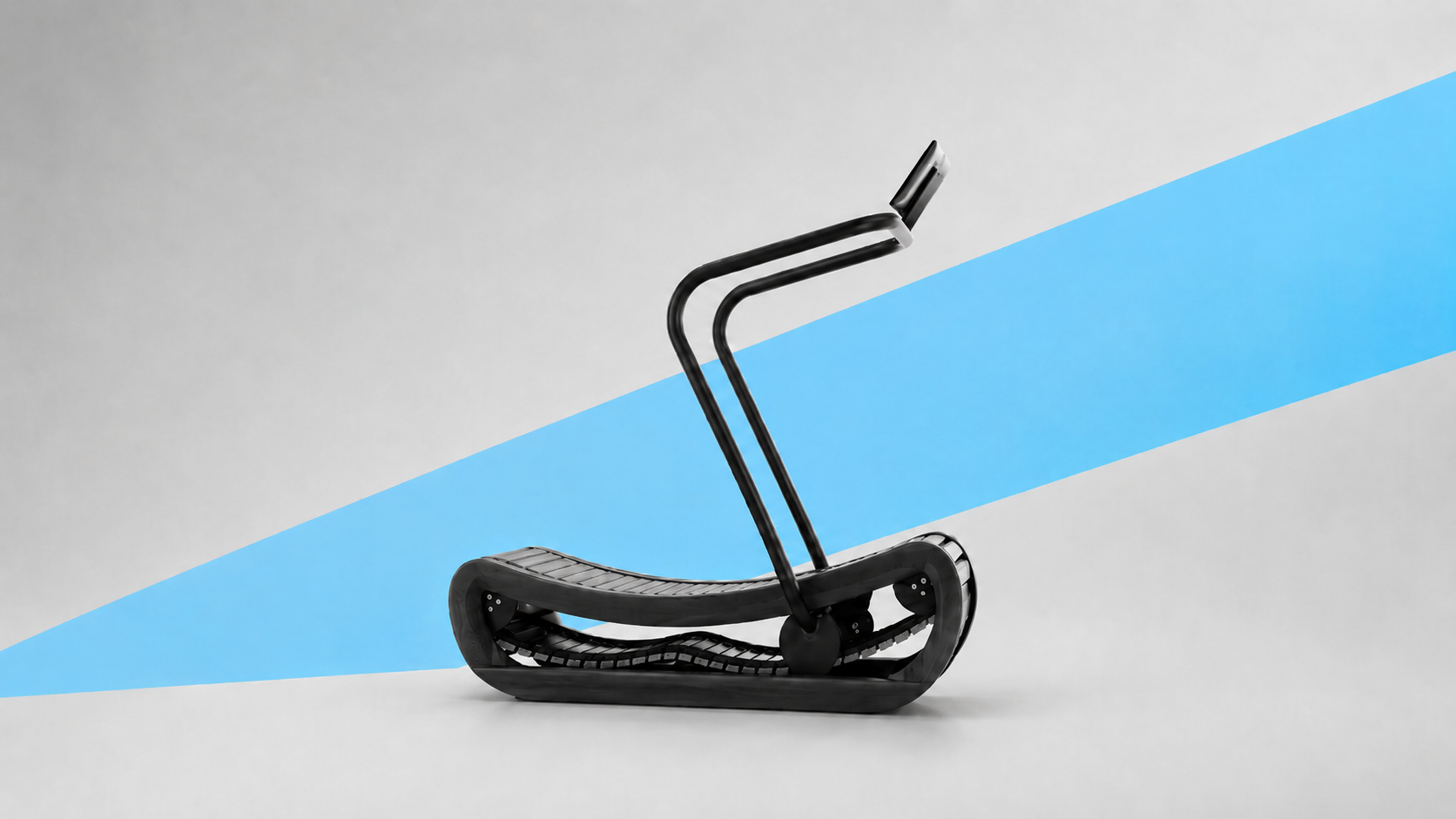
A curved treadmill is a running machine with a curved, slatted belt and no motor. The running surface arcs upward at both ends, and the belt is moved entirely by your own stride rather than by an electric motor. You will see the same machine sold under a confusing number of names, all of which mean essentially the same thing: a manual treadmill, a self-powered or self-propelled treadmill, a non-motorised treadmill, a slat treadmill, or an air runner. If a treadmill has a curved deck, it is almost always one of these.
The design came out of athletic and rehabilitation training, where the goal was a machine that made the runner do all the work and encouraged a cleaner gait. It has since spread into commercial gyms, CrossFit boxes and, increasingly, home gyms, on the back of the popularity of HIIT and functional training.
How does a curved treadmill work?
You control the speed with your feet, not with buttons. Move higher up the curve, towards the front, and the belt speeds up. Drift back towards the centre and it slows down. Step off the curve entirely and it stops. There is no set pace to keep up with and no lag: the belt responds instantly to what you do, which is what makes these machines so well suited to sprint intervals.
Because you are providing all the power, running on a curve feels considerably harder than the same speed on a motorised belt. That is the point of the machine rather than a fault, but it does mean there is a genuine learning curve. Most people find the first few sessions awkward before the movement starts to feel natural.
Are all curved treadmills manual?
In practice, yes. The curved shape and the manual, motor-free mechanism go together: the curve is what lets you drive the belt with your own stride, so nearly every curved treadmill on the market is a manual, self-powered machine. This is why the search terms curved treadmill, manual treadmill and self-powered treadmill so often return the same products. There are flat manual treadmills too, generally cheaper and cruder, but when people talk about a curved treadmill they almost always mean the self-powered slat type described here.
Curved treadmill benefits
The appeal of a curved treadmill comes down to a handful of genuine advantages, most of which follow from the simple fact that you, not a motor, are doing the work.
You burn more calories. This is the headline claim, and it holds up. Studies comparing the two formats at a matched pace consistently find higher heart rate and oxygen consumption on a curved treadmill, with most research putting the increase in energy expenditure at roughly 20 to 30 per cent. A 2018 study in the Journal of Science and Medicine in Sport found significantly higher physiological demand on self-powered curved machines at the same speed. In plain terms, you get more out of the same number of minutes.
It works your posterior chain harder. Because you have to push the belt backwards to move forwards, your glutes and hamstrings do far more than on a motorised deck, where the belt does that work for you. Studies using EMG to measure muscle activity have found meaningfully higher hamstring recruitment on curved treadmills at matched speeds.
It encourages a more natural gait. The curved surface nudges you onto your mid or forefoot and discourages the heavy heel strike that a flat belt allows. Overstriding becomes self-limiting, because reaching too far forward simply does not drive the belt efficiently. Many running coaches consider the resulting form cleaner and easier on the joints.
It is brilliant for HIIT and sprints. The instant, lag-free speed response means you can go from a standstill to a full sprint and back without waiting for a motor to catch up. This is why curved treadmills are a fixture in CrossFit, Hyrox and athletic conditioning.
It needs no electricity and almost no maintenance. With no motor, no electronics and no drive belt to wear out, a curved treadmill uses no power and has very little to go wrong. A well-built one lasts ten to fifteen years in hard commercial use, where a motorised machine would need a new belt every few years and, eventually, a new motor.
Curved treadmill vs flat: how they compare
A flat, motorised treadmill and a curved, manual one are built for different jobs. The table below sets out the practical differences.
| Curved (manual) | Flat (motorised) | |
|---|---|---|
| Power | You power the belt | An electric motor |
| Calorie burn | Roughly 20 to 30% higher at matched effort | Baseline |
| Speed control | By foot position, instant | Buttons, with motor lag |
| Top speed | As fast as you can drive it | Capped, usually 12 to 14 mph (19 to 22 km/h) |
| Incline | Fixed curve, no adjustment | Often adjustable, powered |
| Best for | HIIT, sprints, conditioning | Steady runs, walking, rehab |
| Electricity | None | 600 to 1,500 watts in use |
| Maintenance | Very little, no belt to replace | Belt every few years, motor eventually |
| Learning curve | Real, takes a few sessions | None |
| Typical price | £1,500 to £10,000 and beyond | £300 to £2,000 for home use |
The downsides you should weigh
Curved treadmills are not simply better machines, and it would be dishonest to present them that way. They come with real trade-offs.
- Higher calorie burn for the same time
- Stronger posterior-chain and glute work
- Natural forefoot gait, self-limiting overstride
- Instant response, ideal for HIIT and sprints
- No electricity, very long service life
- Expensive, often several thousand pounds
- Hard work, with a genuine learning curve
- Large and very heavy, hard to move
- Fixed curve, no incline or decline control
- Cheaper models offer little data or programming
The cost and the effort are the two that catch people out. These are not machines for a gentle daily walk in front of the television, and they are not cheap enough to buy on a whim. If your goal is steady-state cardio, walking or a return to fitness, a curved treadmill is the wrong tool, and a good motorised treadmill will serve you better for a fraction of the price.
How much does a curved treadmill cost?
This is where most people get a surprise. Curved treadmills are markedly more expensive than motorised machines, and the good ones are a serious investment. Prices in the UK fall into three broad tiers.
| Tier | What you get |
|---|---|
| Budget, around £500 to £1,500 | Imported and lesser-known brands. The self-powered experience is there, but build quality, belt smoothness and warranty vary a great deal. Worth approaching with care. |
| Mid, around £2,500 to £4,000 | The credible home and light-commercial names, such as the Assault Runner and TrueForm Runner. Solid slat belts, app connectivity on some, and warranties that mean something. |
| Premium, around £6,000 to £10,000 and above | Commercial gold-standard machines: the NoHRD SprintBok, the Woodway Curve and the Technogym SkillMill. Built to run all day for a decade or more, priced accordingly. |
For context, the NoHRD SprintBok we reviewed sits in that top tier at close to £6,000, while a Woodway Curve is around £9,900 and a new Technogym SkillMill more again. The accessible end of the market starts to make sense at around £2,000 to £2,500 once you want a machine that will last.
The main curved treadmill brands
A handful of names dominate the category, each with a slightly different focus.
Woodway Curve. The original and the machine most others are measured against, known for its patented slat belt and cushioning. Premium priced and built for commercial use.
Technogym SkillMill. A commercial machine with adjustable magnetic resistance, so it doubles as a sled-push trainer as well as a runner. A fixture in performance gyms.
Assault Runner. The more accessible, functional-fitness choice, with Bluetooth and ANT+ connectivity that pairs with apps such as Zwift. Popular in CrossFit.
TrueForm Runner. A US-designed slat treadmill aimed at runners and coaches, with a responsive belt and a strong following for gait work.
NoHRD SprintBok. A distinctive wooden-framed premium machine that suits everyone from professional athletes to those on a couch-to-5K plan. It is the one curved treadmill we have reviewed in depth: see our full NoHRD SprintBok review for how it performs and whether it justifies the price.
Alongside these sit a growing number of budget and mid-range options, from Primal Strength and Half Human to a range of imported machines, which broaden the choice at the lower end.
Can you have a curved treadmill at home?
You can, and more people are, but three things are worth thinking about before you commit. The first is cost, covered above: a home-worthy machine is a four-figure purchase. The second is space and weight. Curved treadmills are large and heavy, often 150 kg or more, so they are not something you shuffle into a cupboard between sessions, and very few fold in any meaningful way. The third is what you actually want from it. If you are chasing hard, time-efficient conditioning and you will use the intensity, a curved treadmill at home is a genuinely rewarding piece of kit. If you mostly want to walk or jog steadily, the money is better spent elsewhere.
Are curved treadmills worth it?
For the right person, yes. If you train for performance, do a lot of HIIT or sprint work, value the harder workout and the natural running form, and intend to keep the machine for years, a curved treadmill earns its keep and then some. The durability alone changes the maths over a decade of use.
For most home buyers, though, it is no. The price is high, the workout is punishing, and the specific benefits matter most to people already training seriously. If that is not you, a good motorised machine or a walking pad will get you fitter for far less money and far less effort. We would rather point you to the right tool than sell you an expensive one you will not enjoy: our best home treadmills and best walking pads guides are the better starting point if a curved treadmill sounds like more machine than you need.
Common questions
What is a curved treadmill called?
Several things, all meaning much the same machine: a manual treadmill, a self-powered or self-propelled treadmill, a non-motorised treadmill, a slat treadmill, or an air runner. They all describe a treadmill with a curved, slatted belt that you power with your own stride rather than a motor.
Do curved treadmills really burn more calories?
Yes. Because you power the belt yourself, studies comparing the two formats at the same pace consistently find higher heart rate and oxygen use on a curved treadmill, with most research putting the increase at roughly 20 to 30 per cent. You also recruit your glutes and hamstrings more, so the workout is harder for the same time spent.
How do you use a curved treadmill?
You control the speed with your feet. Move higher up the curve towards the front to speed up, drift back towards the centre to slow down, and step off to stop. There are no speed buttons and no motor lag, so the belt responds instantly. Expect the first few sessions to feel awkward before the movement becomes natural.
Why are curved treadmills so expensive?
They are built to commercial standards with heavy steel frames and precision slat belts designed to run for a decade or more, and there is no cheap way to make that mechanism well. Quality machines run from around £2,500 into five figures, though budget imports exist below that with the usual trade-offs in build and warranty.
Can you walk on a curved treadmill?
You can, and walking is a good way to learn the machine, but it is not what these treadmills are built for. Their strength is high-intensity running and sprint work. If walking is your main aim, a motorised treadmill or a walking pad is more comfortable and far cheaper.
Are curved treadmills good for beginners?
They are demanding, so a complete beginner may find one discouraging at first. That said, better machines suit a wide range of users, from athletes to those starting a couch-to-5K plan, precisely because you set your own pace. If you are new to exercise and want the gentlest possible start, a motorised treadmill is the easier entry point.
HomeTreadmill is reader-supported. When you buy through links on our site we may earn an affiliate commission, at no extra cost to you. Prices and specifications are checked regularly but can change, so confirm the current details with the retailer before purchase. This guide is general information and not medical or training advice.