
First person
I review walking pads and treadmills for a living, so I know them on paper better than most. Living with one is a different thing entirely. After a year of working from home left me stiff and sluggish between runs, I set myself a 30 day walking pad challenge and used a pad at my desk every working day for a month. Here’s the honest account, downsides and all.
If you work from home, you’ll recognise the slow creep. You sit down at nine, you stand up at six, and the only thing that really moved all day was your mouse hand. The days blur into each other, your back stiffens, and you somehow finish them worn out despite having done nothing remotely physical. That was me for the best part of a year, which is faintly absurd for someone who runs several times a week and spends the rest of his time reviewing treadmills and walking pads and arguing about deck cushioning with strangers online. The running was fine. It was the eight hours wrapped around it, parked in a chair, that had quietly gone to seed. When I finally bothered to check, I was averaging about 1,900 steps on a normal desk day, which is roughly what you’d manage if you counted trips to the kettle as exercise.
Here’s the thing about covering this kit for a living. You get to know a machine quickly, score it against the rest, and move on to the next one. You learn what a walking pad is. What you don’t learn is what it’s actually like to have one under your desk every working day for a month, which is the only thing that matters to someone deciding whether to buy. So this time I kept one there and used it properly.
I’m deliberately not naming the pad I used. At this end of the market the machines are more alike than the marketing makes out, and singling one out would imply a brand verdict I’m not making here. This piece is about what living with a walking pad is actually like, not which box to buy. When you do want specific models, the best walking pads in the UK guide is where I get into that.
The first week was clumsy
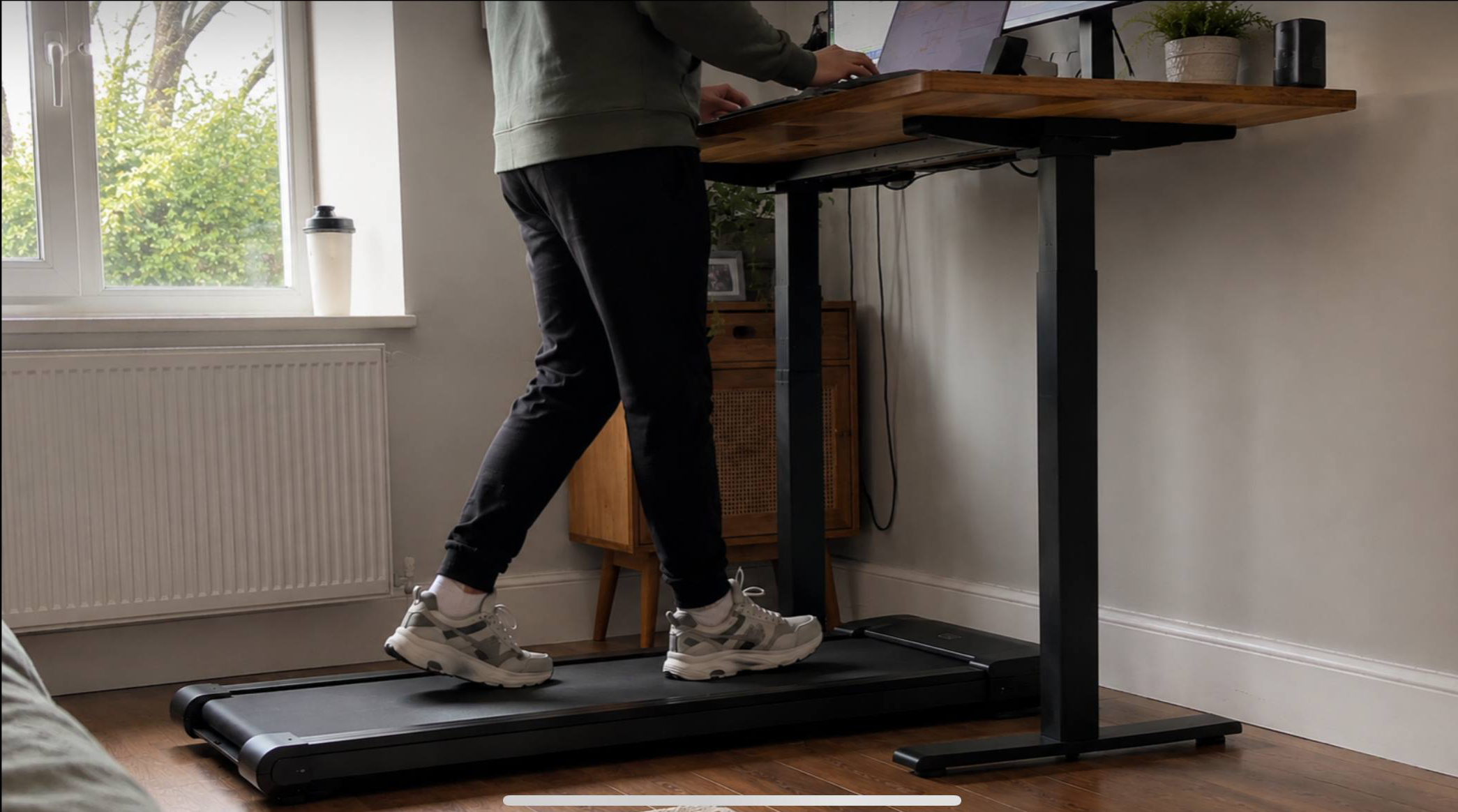
Day one taught me you can’t just stride off, which as a runner I found mildly humbling. I set off at something like a normal walking pace and spent the next ten minutes firing out emails full of typos while my empty chair watched from behind me like a disappointed relative. The pace that actually works is about 1.5 mph. Slow enough to keep your hands steady on the keys, quick enough that you’re clearly walking and not just shuffling on the spot.
The other thing you learn fast is what you can and can’t do while moving. Reactive stuff is fine, things like email, reading, Slack, first drafts and the small admin of running things. Anything that needs real concentration, like untangling a spreadsheet or proper editing, I ended up doing sat down. The pad doesn’t replace your chair. It replaces the hours you’d otherwise spend glued to it.
What the 30 day walking pad challenge actually changed
The steps were the obvious win, and they weren’t subtle. A normal working day added six or seven thousand of them without me leaving the house, which dragged my desk-day total from frankly embarrassing up to something respectable. This was never going to replace a proper run, and it didn’t try to. What it changed was the eight hours in between, the ones I’d been spending bolt upright and motionless. If you want a rough idea of what that movement is actually worth, our walking pad calorie calculator will run the numbers on your own pace and weight.
The bit I didn’t see coming was the afternoon. That dead hour after lunch where I’m normally losing a slow fight with my own eyelids turned into one of my better walking stretches. Pottering along kept me awake far better than a third coffee ever has, and I’d often finish the day feeling sharper than I did before the pad arrived. That part isn’t just me talking myself into it. A 2026 meta-analysis of randomised trials found that breaking up sitting with light activity like walking gave a small, short-term lift to executive function, with the clearest effects on working memory and reaction time. The researchers are careful to call the evidence low-certainty and the effect modest, so I’m not about to claim a walking pad turns you into a genius, but it lines up neatly with the afternoons I actually had. By week three I was flicking it on at 2pm without really deciding to.
It also did something for my running I hadn’t expected. It kept my legs gently ticking over on rest days, the kind of easy movement that loosens you off rather than tiring you out. If you’d rather follow a plan than just amble, our walking pad workouts set out seven easy routines built around a working day, including the Japanese interval walking one that does most of the actual fitness work.
Now the downsides, because there are some
Video calls are where it falls down. A cheap pad with a noisy motor will tell everyone on the call exactly what you’re up to, and even a quiet one puts a faint bounce in your voice that gives the game away. I started pausing it for anything client facing. For internal calls where I was mostly listening and nodding, walking was fine, and if anything it kept me more switched on.
Then your body has opinions. The first week left the soles of my feet aching by the evening, the way they do after a day stood on a trade show floor, which surprised me given how much running my feet are used to. Standing and shuffling all day is a different load to a run. Decent trainers instead of socks sorted most of it, and it faded once my feet got the message. If your knees or hips are dodgy, ease into it, and pay more attention to belt size and cushioning than to a top speed you’re never going to use.
Noise, shoes, something to protect the floor underneath, and where on earth you put the thing when people come round. None of it was a dealbreaker. All of it is the stuff the glossy product photos leave out.
The spec I’d been getting wrong
Here’s the part that actually changed how I do my job. When I review a pad over a few days, I weight the things that are easy to measure, the top speed, the motor wattage, the headline numbers that fit in a comparison table. A month of real use quietly rearranged that list. The spec that decided whether I used the pad or left it switched off was deck length, and it barely gets a mention on most product pages. A belt that felt perfectly fine for a ten minute review stride turned out to be half an inch too short for the way my feet drift when I stop concentrating and start typing, and I clipped the back edge more times than I’d admit. Speed I never touched above a stroll. Deck length I noticed every single day. I’ve since reordered how I score them, and it’s the first thing I now tell anyone to check before they’re seduced by a big top-speed number they’ll never use.
So, was it worth it?
For me, yes, with one honest caveat. A walking pad will not train you for a marathon, and as a runner I’d never pretend otherwise. The faster, harder work that builds real cardiovascular fitness still happens elsewhere. What a pad does is something quieter but, for most desk workers, more useful day to day. It kills off the sitting, turning the dead hours of a desk job into steady low-intensity movement you barely notice doing. That alone counts for plenty, and it’s why it’s one of the easier routes into losing weight without a miserable routine, because there’s nothing to grit your teeth through.
If you work from home, sit most of the day, and winced a bit at that 1,900 figure, it’s one of the few bits of kit I’ve used that changed a daily habit instead of gathering dust in a corner. You don’t have to be a runner for it to be worth it. You arguably benefit more if you’re not. Buy on motor noise and belt size rather than the spec sheet, give your feet a week to settle in, and keep the chair for the hard thinking.
I recommend these machines to readers all the time. It took living with one to properly understand why. Thirty days on, mine’s still under the desk, and the chap who reviews treadmills for a living is telling you to take the slower machine seriously. That tells you more than any number.
This is a personal account, not a personalised training plan. Consult a GP before starting a new exercise programme if you have existing health conditions.