
Comparison guide
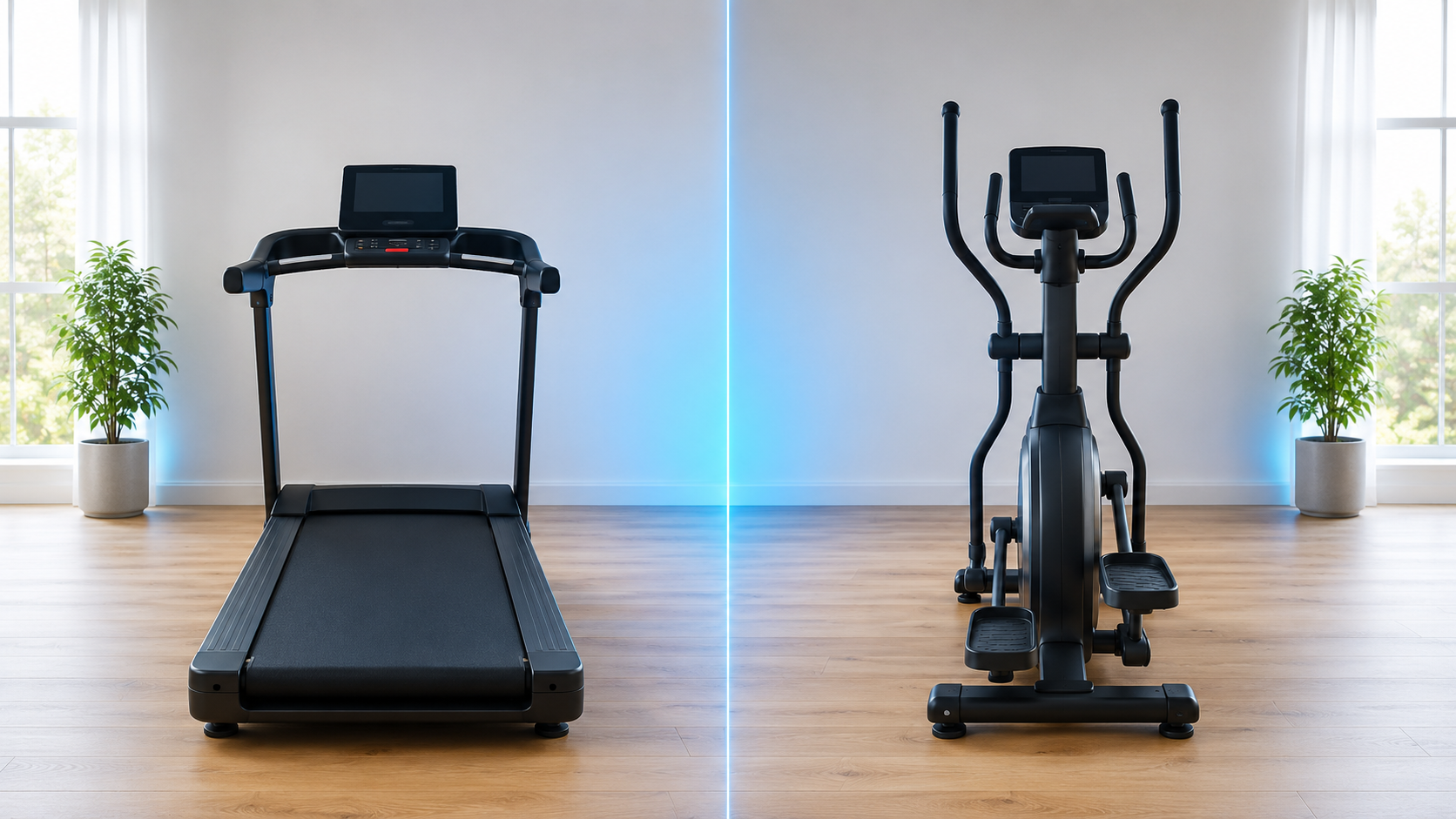
Both machines give you a serious cardio workout at home, and both will help you lose weight. But they are not the same tool. One asks your body to carry its own weight, and one deliberately takes that weight away. That single difference decides almost everything else, from how many calories you burn to what it does to your knees. Here is how the cross trainer and the treadmill actually compare, and how to work out which belongs in your house.
Neither is better outright. The treadmill burns slightly more calories at a running pace, builds bone density because it is weight-bearing, and is the only choice if you actually want to run. The cross trainer is far gentler on your joints, works your upper body as well, and lets most people train more often without aches.
Put simply, choose the treadmill if you want to run, want the highest calorie burn per minute, or care about bone health. Choose the cross trainer if your knees, hips or back give you trouble, or if you want a full-body workout you can do daily without soreness.
Better for
- Running and race training
- The highest calorie burn per minute
- Bone density, since it is weight-bearing
- Steep incline work and hill sessions
- Walking, which most people already do well
Better for
- Sore knees, hips, ankles and backs
- Returning to exercise after injury
- Working the upper body as well as the legs
- Long, steady sessions without joint fatigue
- Quieter running, no footfall thud
Cross trainer vs treadmill at a glance
| Factor | Treadmill | Cross trainer | Winner |
|---|---|---|---|
| Calories burned | Around 372 in 30 minutes at a 10 minute mile | Around 335 in 30 minutes | Treadmill |
| Joint impact | High, you land with each stride | Very low, feet never leave the pedals | Cross trainer |
| Muscles worked | Legs, glutes, core | Legs, glutes, core, plus arms, chest and shoulders | Cross trainer |
| Bone density | Weight-bearing, so it helps | Not weight-bearing, so it does not | Treadmill |
| Running specificity | Trains the exact movement | Does not carry over to running | Treadmill |
| Ease of use | Walking is instinctive | Takes a session or two to feel natural | Treadmill |
| Noise | Motor plus the thud of footfall | Quieter, no impact noise | Cross trainer |
| Space and storage | Many fold, some fold flat | Rarely folds, tends to stay put | Treadmill |
| Price for a decent machine | Roughly £500 upwards | Roughly £400 upwards | Close |
Which burns more calories?
The treadmill, but by less than most people assume. Harvard Health’s published estimates put a person of around 70 kg at roughly 372 calories in 30 minutes of running at a 10 minute mile pace, against roughly 335 calories in 30 minutes on a cross trainer. That is a difference of about 11 percent, or a slice of toast.
The reason is simple. On a treadmill you support your own body weight and lift it with every stride. On a cross trainer the machine holds you up and your feet never leave the pedals, so some of that work disappears. It is the same reason the cross trainer is kinder to your knees, and the two facts cannot be separated.
Two things are worth saying about those numbers, though. First, research comparing the two at a self-selected intensity, meaning people simply working as hard as they felt like working, has found the gap narrows considerably. If you push harder on the cross trainer, you close it. Second, these figures compare running with a moderate cross trainer session. Flat treadmill walking burns considerably less than a cross trainer, so the machine only wins if you actually run on it.
The honest version. The calorie gap between these machines is smaller than the gap between the workout you will do three times a week and the workout you will abandon in March. Pick the one you will keep using.
Which is better for weight loss and fat loss?
Weight loss comes from a sustained calorie deficit, so on paper the treadmill’s slightly higher burn gives it the edge, particularly if you like high intensity intervals, where running is very hard to beat for calories per minute.
In practice the picture is less tidy. Because the cross trainer does not batter your joints, most people can use it more often and for longer without needing a recovery day. Four comfortable 45 minute cross trainer sessions will beat two punishing treadmill runs and a week of sore shins. Fat loss is a question of what you can sustain for months, and adherence usually decides it rather than calories per minute.
Neither machine will target belly fat specifically. Nothing does. Where fat comes off is not something you can direct, and any product claiming otherwise is selling something.
Joints and impact: the real dividing line
This is the difference that should drive your decision, and it is not close. Every time you run, you land with a force of several times your body weight, absorbed by your ankles, knees, hips and lower back. A good treadmill deck cushions some of that, and running on one is gentler than pavement, but the impact is inherent to the movement.
On a cross trainer your feet stay in contact with the pedals throughout. There is no landing, so there is no impact. That is why cross trainers are so often recommended for people with arthritis, for those carrying more weight, and for anyone rebuilding after a knee or ankle injury.
If you have a joint condition or you are coming back from injury, this is worth a conversation with a GP or physiotherapist rather than a purchase decision made from an article. They will know your knee. We do not.
Muscles worked: full body or lower body
A treadmill is a lower body machine. It works your quads, hamstrings, calves and glutes, and your core does quiet stabilising work throughout. Add incline and the glutes and hamstrings take on considerably more.
A cross trainer does that too, but the moving handlebars bring your chest, shoulders, back and arms into it. If a full-body session appeals, or you want to get more out of one piece of equipment, that is a genuine advantage. The caveat is that plenty of people rest their hands on the bars and let their legs do everything anyway, which quietly turns it back into a lower body machine.
Bone density: the treadmill’s quiet advantage
This is the point most comparisons skip. Bone responds to being loaded. Weight-bearing exercise, where your skeleton carries your body against gravity, signals your bones to maintain and build density. Walking and running do this. Cross training, where the machine carries you, largely does not.
For younger people this matters little. For anyone concerned about bone health as they age, particularly women after menopause, it is a real consideration, and it is a reason many people end up walking on a treadmill rather than gliding on a cross trainer even though the cross trainer feels easier.
Cross trainer vs incline treadmill
A fair fight, this one, and a common question. Walking on a steep incline is the closest a treadmill comes to a cross trainer’s blend of high effort and low impact. Incline walking raises the heart rate sharply, targets the glutes and hamstrings hard, and because you are walking rather than running the impact stays low.
At a brisk walk on a 10 to 12 percent gradient, calorie burn is comparable to a moderate cross trainer session, and you keep the bone-loading benefit. This is exactly the appeal of the 12-3-30 workout. If you want low impact but do not want to give up weight-bearing exercise, a treadmill with a proper powered incline is a strong middle path. Our best treadmills with incline guide covers the machines that do it well.
What about an exercise bike?
Worth a mention, since people often weigh all three. A bike is the lowest impact of the lot and the easiest on the knees, it takes up the least room, and you can read or watch something while you use it. What you give up is any upper body work, any weight-bearing benefit, and, for most people, a slightly lower calorie burn than either of the other two at a comparable effort. It is the machine you use if impact is completely off the table.
Which should you buy?
| You want to run | Treadmill. No contest. A cross trainer does not train the movement, and the carry-over to running is minimal. |
| Your knees hurt | Cross trainer. Or a treadmill used for incline walking rather than running, which keeps the impact low. |
| Maximum calories, limited time | Treadmill. Running intervals burn more per minute than anything else here. |
| Full-body workout | Cross trainer. The moving handlebars are the only upper body work on offer. |
| Bone health matters | Treadmill. It is weight-bearing. Even walking on it counts, and a cross trainer does not. |
| You live in a flat | Cross trainer for the lack of footfall noise, though a good treadmill on a mat is quieter than people expect. |
| Space is tight | Treadmill, since many fold and some fold flat enough to slide under a bed. Cross trainers rarely fold at all. |
| You are new to exercise | Either, and honestly whichever you will enjoy. A cross trainer lets you build intensity quickly without soreness. A treadmill lets you simply walk, which needs no learning at all. |
The verdict
If you can run without pain and you want the most efficient calorie burn, the strongest bones and a machine that trains an actual skill, buy the treadmill. If your joints protest, if you want your arms involved, or if you know yourself well enough to know you will train more often on something that does not leave you aching, buy the cross trainer.
And if you are somewhere in between, which most people are, consider a treadmill with a powered incline. Walking at a steep gradient gets you most of the cross trainer’s low-impact benefit while keeping the weight-bearing advantage that only a treadmill offers. In our view it is the most flexible single machine you can put in a spare room.
Ready to look at treadmills?
If the treadmill is the machine for you, these guides are the place to start. Every model is scored with our RunRank system.
Frequently asked questions
Is a cross trainer or treadmill better for weight loss?
The treadmill burns slightly more calories per minute, roughly 372 against 335 in half an hour for a person of about 70 kg, so on paper it edges it. But weight loss depends on a sustained calorie deficit over months, and most people manage more sessions on a cross trainer because it does not leave them sore. The better machine for weight loss is the one you will still be using in six months.
Does a cross trainer burn more calories than a treadmill?
No, not at a comparable effort. Harvard Health’s estimates put a treadmill run ahead by around 11 percent. The gap narrows when people simply work at whatever intensity they choose rather than to a set pace, and it reverses entirely if you compare a cross trainer with flat treadmill walking.
Is a cross trainer better for bad knees?
Generally yes. Your feet never leave the pedals, so there is no landing and no impact through the knee. Running is the opposite, with each stride landing at several times your body weight. If your knees are the deciding factor, a cross trainer or incline walking on a treadmill are the two sensible options, and a physiotherapist is a better guide than any article.
What are the benefits of a cross trainer over a treadmill?
Three main ones. Very low joint impact, so you can train more often. Upper body involvement through the moving handlebars, which a treadmill cannot offer. And less noise, since there is no footfall. What you give up is running specificity, bone-loading benefit and a little calorie burn.
Can you lose belly fat on a cross trainer or a treadmill?
Both will help you lose fat overall, and neither will target your belly specifically. Spot reduction is not something the body does. Fat comes off across the whole body in a pattern set largely by genetics, so consistent cardio, some strength work and a sensible diet will do far more than choosing between these two machines.
Is a treadmill or cross trainer better for beginners?
A cross trainer is easier on the body, so you can build intensity without waking up sore, and that helps a habit stick. A treadmill is easier to use, because walking needs no technique at all. If you are starting from a standing start, either works. Choose on your joints and your space rather than your fitness level.
Calorie figures are published estimates for a person of roughly 70 kg and will vary with your weight, fitness and effort. This article is general information rather than medical advice, and anyone with a joint condition, an injury or a health concern should speak to a GP or physiotherapist before starting a new form of exercise. HomeTreadmill.co.uk is reader-supported: if you buy through links on this site we may earn a commission, at no extra cost to you. This does not influence our recommendations. Every machine is assessed independently using our RunRank system.