
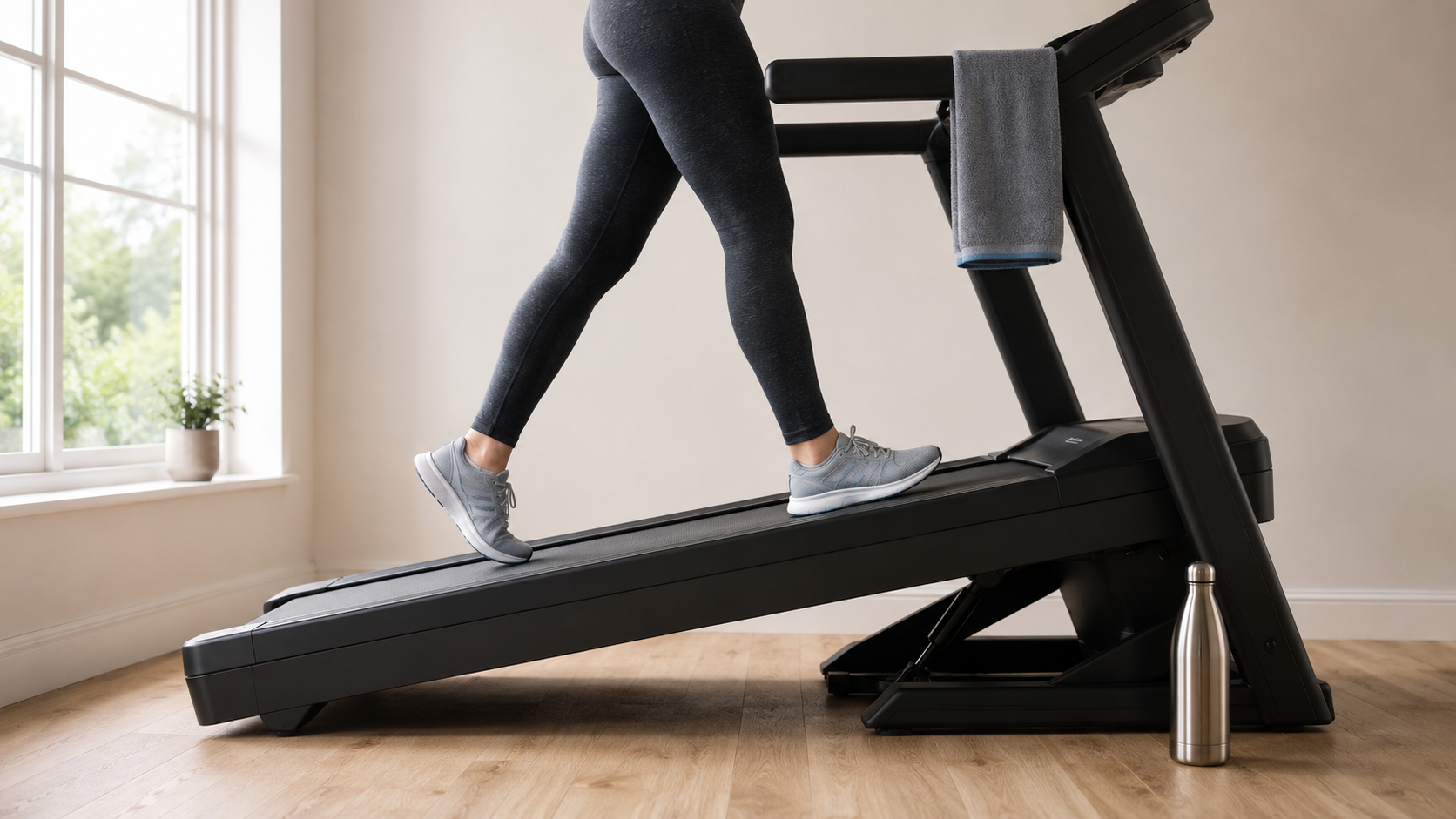
Incline walking is the most efficient cardio you can do on a treadmill. At 12 per cent incline and a brisk walking pace, you’ll burn close to the same calories as running at 6 mph on flat ground, with a fraction of the joint impact and none of the running shoe wear. The seven workouts below cover every level from absolute beginner walking pad sessions through to advanced hill repeats for runners. All speeds are in mph, incline figures are the percentages shown on your treadmill console, and every workout is timed to fit a standard 20 to 45 minute session.
Why Incline Beats Flat For Most People
The mechanics are straightforward. Walking uphill recruits your glutes and hamstrings far more than walking on flat ground, and the elevated heart rate at walking pace puts you squarely in the fat-burning Zone 2 to 3 range without the impact of running. For UK buyers thinking about losing weight on a treadmill, incline is genuinely the most efficient programme you can follow without taking up running.
A note on machines. Most treadmills under £400 max out at 3 per cent incline, which limits the workouts in this guide to the walking pad routine below. If you want the full range, you need a machine with at least 10 per cent incline. See our best treadmills with incline guide for current picks.
The 7 Incline Workouts at a Glance
| Workout | Duration | Level | Peak Incline | Calories* |
|---|---|---|---|---|
| 12-3-30 | 30 min | Beginner | 12% | 250-300 |
| Beginner Incline Walk | 30 min | Beginner | 8% | 200-280 |
| Walking Pad Incline | 20 min | Beginner | 5-7% | 120-180 |
| Incline Pyramid | 35 min | Intermediate | 10% | 300-400 |
| Fat Burn Steady Hill | 40 min | Intermediate | 7% | 320-420 |
| Incline HIIT | 30 min | Intermediate | 10% | 300-400 |
| Advanced Hill Repeats | 45 min | Advanced | 8% | 500-600 |
*Calorie estimates based on a 70 kg user. Your actual burn varies with body weight, fitness, and effort.
1. The 12-3-30 Workout
12-3-30: Walk at 12% Incline, 3 mph, for 30 Minutes
Beginner| Time | Speed | Incline | Notes |
|---|---|---|---|
| 0-30 min | 3.0 mph | 12% | Steady pace, no holding the handrails |
For the full breakdown of who created it, the science behind it, and how to progress beyond 30 minutes, see our complete 12-3-30 treadmill workout guide.
2. Beginner Incline Walk (30 Minutes)
Progressive Incline Walk for First-Timers
Beginner| Time | Speed | Incline | Effort |
|---|---|---|---|
| 0-5 min | 3.0 mph | 0% | Warm-up walk |
| 5-10 min | 3.5 mph | 4% | Easy hill |
| 10-15 min | 3.5 mph | 6% | Moderate hill |
| 15-20 min | 3.0 mph | 8% | Steep hill, slow pace |
| 20-25 min | 3.5 mph | 6% | Back down |
| 25-30 min | 3.0 mph | 0% | Cool-down walk |
3. Walking Pad Incline Workout (20 Minutes)
Limited-Incline Walking Pad Routine
Beginner| Time | Speed | Incline | Effort |
|---|---|---|---|
| 0-3 min | 2.5 mph | 0-3% | Warm-up |
| 3-7 min | 3.0 mph | 5% | Moderate effort |
| 7-11 min | 3.5 mph | 7% | Brisk effort |
| 11-15 min | 3.7 mph | 5% | Power walk |
| 15-18 min | 3.0 mph | 7% | Final hill |
| 18-20 min | 2.5 mph | 0-3% | Cool-down |
4. Incline Pyramid (35 Minutes)
Up-and-Down Pyramid Hill Walk
Intermediate| Time | Speed | Incline | Effort |
|---|---|---|---|
| 0-5 min | 3.5 mph | 0% | Warm-up |
| 5-8 min | 3.8 mph | 2% | Easy climb |
| 8-11 min | 3.8 mph | 4% | Steady |
| 11-14 min | 3.8 mph | 6% | Moderate |
| 14-17 min | 3.5 mph | 8% | Hard |
| 17-20 min | 3.5 mph | 10% | Peak (top of pyramid) |
| 20-23 min | 3.5 mph | 8% | Descend |
| 23-26 min | 3.8 mph | 6% | Moderate |
| 26-29 min | 3.8 mph | 4% | Easy |
| 29-32 min | 4.0 mph | 2% | Power walk finish |
| 32-35 min | 3.0 mph | 0% | Cool-down |
5. Fat Burn Steady Hill (40 Minutes)
Long Steady-State Incline for Sustainable Fat Loss
Intermediate| Time | Speed | Incline | Effort |
|---|---|---|---|
| 0-5 min | 3.0 mph | 0% | Warm-up |
| 5-25 min | 3.8 mph | 5% | Steady moderate hill |
| 25-35 min | 3.8 mph | 7% | Steady firm hill |
| 35-40 min | 3.0 mph | 0% | Cool-down |
6. Incline HIIT (30 Minutes)
High-Intensity Incline Intervals
Intermediate| Time | Speed | Incline | Effort |
|---|---|---|---|
| 0-5 min | 3.5 mph | 1% | Warm-up |
| 5-6 min | 5.0 mph | 8% | HARD interval |
| 6-8 min | 3.0 mph | 1% | Recovery |
| 8-9 min | 5.0 mph | 8% | HARD interval |
| 9-11 min | 3.0 mph | 1% | Recovery |
| 11-12 min | 5.0 mph | 10% | HARD interval |
| 12-14 min | 3.0 mph | 1% | Recovery |
| 14-15 min | 5.0 mph | 10% | HARD interval |
| 15-17 min | 3.0 mph | 1% | Recovery |
| 17-18 min | 5.0 mph | 10% | HARD interval |
| 18-20 min | 3.0 mph | 1% | Recovery |
| 20-25 min | 3.8 mph | 5% | Steady moderate |
| 25-30 min | 3.0 mph | 0% | Cool-down |
7. Advanced Hill Repeats (45 Minutes)
Running Hill Repeats for Trained Runners
Advanced| Time | Speed | Incline | Effort |
|---|---|---|---|
| 0-10 min | 5.5 mph | 1% | Warm-up jog |
| 10-13 min | 7.0 mph | 6% | Hill rep 1 |
| 13-15 min | 5.0 mph | 1% | Recovery jog |
| 15-18 min | 7.0 mph | 6% | Hill rep 2 |
| 18-20 min | 5.0 mph | 1% | Recovery jog |
| 20-23 min | 7.5 mph | 7% | Hill rep 3 |
| 23-25 min | 5.0 mph | 1% | Recovery jog |
| 25-28 min | 7.5 mph | 7% | Hill rep 4 |
| 28-30 min | 5.0 mph | 1% | Recovery jog |
| 30-33 min | 8.0 mph | 8% | Hill rep 5 (peak) |
| 33-35 min | 5.0 mph | 1% | Recovery jog |
| 35-38 min | 8.0 mph | 8% | Hill rep 6 (final) |
| 38-45 min | 4.5 mph | 0% | Cool-down |
Form check
On any incline workout above 6 per cent, the temptation is to lean forward and grip the handrails. Don’t. Stand tall with your hips stacked under your shoulders and let your legs do the work. Holding the handrails reduces calorie burn by up to 25 per cent and shifts load from your glutes to your shoulders. If you genuinely need the handrails for balance, drop the incline by 2 per cent until you can walk hands-free.
How Often Should You Do Incline Workouts?
Most people benefit from 3 to 5 incline sessions a week. The mix depends on your goal:
- Fat loss as the priority: 4-5 sessions, mostly the 12-3-30 or Fat Burn Steady Hill, with one HIIT session a week
- General fitness: 3 sessions, alternating Beginner Incline Walk and Incline Pyramid
- Race training (5K/10K): 2 hill sessions a week, with the remaining 3 sessions being flat tempo and long runs
- Walking pad daily use: The 20-minute walking pad workout can be done every day without overtraining, since it’s all walking pace
Beginners should start with 2 sessions a week and add a third only after the first fortnight. Calf muscles take 7 to 10 days to adapt to regular incline loading, and most early dropouts happen because people skip this adaptation phase and end up with sore Achilles tendons.
Best treadmills for incline workouts
If you’re picking a machine specifically for the workouts in this guide, look for at least 10 per cent power incline and a deck length of 140 cm or more so you can stride properly on the steeper grades.
- Reebok Jet 200 (15% incline, ~£599) — best mid-range option, 15 levels of incline outclass most under-£800 machines
- NordicTrack T Series 8 (12% incline, ~£1,299) — best balance of incline range, deck size, and connected features for these workouts
- NordicTrack X16 & X24 (40% incline, ~£2,999-£3,499) — the only home treadmills with enough incline range to do every workout here plus walking-pad-style 40 per cent hill sessions
- JTX Sprint-7 (12% incline, ~£1,149) — UK-built alternative with strong incline performance and 2-year in-home warranty
For the full picks, see our best treadmills with incline guide.
Incline Treadmill Workout FAQs
What incline percentage is best for fat loss?
For most people, 5 to 12 per cent is the sweet spot. Below 5 per cent the calorie boost over flat walking is modest; above 12 per cent the heart rate climbs into anaerobic territory where the body burns more glycogen and less fat. The 12-3-30 (12 per cent at 3 mph) and the Fat Burn Steady Hill (5-7 per cent at 3.8 mph) above are both designed around this fat-oxidation Zone 2 range.
Can I do incline workouts on a walking pad?
Yes, but with caveats. Most UK walking pads max out at 3 per cent fixed incline, which is too shallow for the 12-3-30 or any of the other Intermediate workouts above. Walking pads with adjustable incline up to 7 per cent (some UREVO and Marcy models) can run the Walking Pad Incline Workout above. For anything steeper than 7 per cent, you need a proper treadmill with powered incline.
How much more does incline walking burn than flat walking?
Walking at 3 mph on 12 per cent incline burns roughly 60 per cent more calories than walking at the same speed on flat ground. A 70 kg person walking flat at 3 mph burns about 180 calories in 30 minutes; the same person doing 12-3-30 burns 280-300 calories in the same 30 minutes. The percentage increase scales with incline up to about 15 per cent, after which the body’s mechanics change and the additional calorie cost flattens.
Is incline walking bad for my knees?
For most people, incline walking is gentler on the knees than flat running and similar to flat walking. The forward-leaning posture reduces the impact force compared to running, and the lower walking speed means each footstrike is less jarring. The exception is downhill walking (decline), which puts more eccentric load on the front of the knee. If you have existing knee issues, stay below 8 per cent incline initially and avoid decline settings.
How long until I see results from incline workouts?
Cardiovascular fitness changes show up first, typically within 2 to 3 weeks of consistent training (3 sessions a week). Visible body composition changes from incline workouts alone usually take 6 to 8 weeks of consistent training combined with a modest calorie deficit. Strength changes in glutes and calves are noticeable within 4 weeks.
Should I run or walk on an incline treadmill?
For most people most of the time, walking is the better choice. Walking at 3 to 4 mph on 8 to 12 per cent incline puts you in the same Zone 2 heart rate as jogging at 5 to 6 mph on flat, with significantly lower joint impact and a much lower injury risk. Reserve incline running for the Advanced Hill Repeats above, and only if you have an existing running base.
Why does my calves hurt the day after an incline workout?
Incline walking loads the calf muscles and Achilles tendons more than flat walking because each footstrike happens with the foot dorsiflexed (toes up). The soreness is normal for the first 7 to 10 days of regular incline training. To minimise it, do a 5-minute flat walking warm-up before every incline session, stretch your calves afterwards, and progress incline percentage gradually rather than jumping straight into 12-3-30 from a sedentary baseline.
Can I hold the handrails on an incline workout?
Briefly for balance is fine; constantly is not. Holding the handrails through an incline session reduces calorie burn by 15 to 25 per cent and transfers work from your legs to your shoulders, defeating most of the point of the workout. If you genuinely need the rails to stay upright, the incline is too steep for your current fitness level. Drop it by 2 per cent and try again.
HomeTreadmill.co.uk is reader-supported. When you buy through links on our site, we may earn an affiliate commission at no extra cost to you. The workouts in this guide are general fitness suggestions, not personalised training plans. Consult a GP before starting a new exercise programme if you have existing health conditions.